


ArticlesThe Complete Texas Tire Guide
Expert advice for buying and maintaining tires in Texas conditions
Texas is tough on tires. Between 100°F+ summers that increase tire pressure by 10 PSI, sudden storms that flood highways, and endless miles of construction zones, your tires face challenges that most generic tire guides completely ignore.
As your trusted Texas tire shop, we help drivers navigate these unique conditions. This guide shares everything we learned about choosing tires, tire maintenance, and maximizing tire life in Texas, from foundational tire knowledge to Texas-specific insights you won’t find anywhere else.
Jump to a Section:
- When to Replace Tires in Texas
- Understanding Tire Specifications
- Choosing the Right Tire Type
- Texas Heat and Tire Pressure
- City Specific Tire Guidance
- Understanding Tire Value and Budget
- Tire Brands Built for Texas
- Frequently Asked Questions
When to Replace Tires in Texas
Tire replacement timing in Texas requires higher standards than federal minimums. Heat and rain dramatically change how tires perform on the road.
Tread Depth: The Texas Standard
While the legal minimum tread depth is 2/32″, Texas drivers face increased hydroplaning risk long before reaching that point. That’s why we recommend replacing tires at 4/32″ in Texas. This extra tread depth reduces stopping distance in heavy rain and significantly lowers hydroplaning risk on flooded roads.
A simple penny test helps check tread depth. Insert a penny into your tire tread with Lincoln’s head upside down. If you can see the top of Lincoln’s head, your tread is at or below 2/32″. In Texas, replace tires when you can see all of Lincoln’s forehead.
Tire Age: Heat Matters
Even with good tread, tires age out. Texas heat and UV exposure accelerate rubber breakdown faster than cooler states.
Best practice:
- Inspect annually after 6 years
- Replace by 10 years maximum
- Replace earlier if sidewall cracking appears
To find your tire’s age, check the DOT code on the sidewall. The last four digits show the week and year of manufacture. Example: 3223 means 32nd week of 2023.
Understanding Your Tire Specifications
Choosing the right tire starts with understanding three critical specifications. These ensure safety, handling, and compatibility with your vehicle.
Reading Tire Size
Find your tire size on the driver’s side door jamb sticker or in your owner’s manual. It looks like this: P225/50R17.
Breaking it down:
- P = Passenger vehicle tire
- 225 = Tire width in millimeters
- 50 = Aspect ratio (sidewall height as percentage of width)
- R = Radial construction
- 17 = Wheel diameter in inches
Always match your vehicle’s recommended tire size. Changing size affects speedometer accuracy, handling, and warranty coverage.
Load Index: Weight Capacity
The load index indicates how much weight each tire can safely support. This number appears after the tire size (example: P225/50R17 98H – the 98 is the load index).
Critical safety rule: Only install tires that meet or exceed your vehicle’s required load index. Undersized tires can fail catastrophically under your vehicle’s weight.
Speed Rating: Performance Capability
The speed rating letter (example: P225/50R17 98H – the H is the speed rating) indicates the maximum speed the tire is designed to handle safely. More importantly, it affects handling capabilities.
Common speed ratings:
- S = Up to 112 mph
- T = Up to 118 mph
- H = Up to 130 mph (common for sedans and SUVs)
- V = Up to 149 mph (performance vehicles)
Choosing the Right Tire Type
Texas drivers use their vehicles in very different ways. Choosing tires that match how and where you drive improves comfort, safety, and tread life.
All-Season Touring Tires
Best for: Most Texas drivers with mixed city and highway driving.
Ideal for daily commuters, family vehicles, and typical metro area driving. These tires balance comfort, durability, and wet traction for year-round Texas conditions.
Why they work in Texas:
- Rubber compounds stay flexible in extreme heat
- Tread patterns channel water during sudden storms
- Heat resistant construction for summer pavement temperatures
Expected tread life: 60,000-80,000 miles
Performance and Ultra High Performance (UHP) Tires
Best for: Sports cars, performance sedans, and driving enthusiasts.
Designed for enhanced dry grip, responsive handling, and aggressive cornering capability. These tires prioritize performance over tread life and comfort.
Texas consideration: Performance tires wear faster in extreme heat and provide reduced traction below 45°F. Best suited for dedicated performance vehicles rather than year-round daily drivers.
Expected tread life: 30,000-50,000 miles
All-Terrain and Rugged Terrain Tires
Best for: Trucks, SUVs, and vehicles used for work or off-road driving.
Built for vehicles that see dirt, gravel, and job site use while still driving highways regularly. These tires grip ranch roads, muddy hunting leases after rain, and unpaved detours around Texas road construction. Perfect for Hill Country access and rural Texas driving.
Trade-off: All-terrain tires produce more road noise than all-season tires. If you spend 90% of time on pavement, all-season comfort beats all-terrain capability. Rugged terrain tires are even more aggressive for serious off-road use but sacrifice additional comfort and fuel economy.
Expected tread life: 50,000-70,000 miles
Highway Light Truck (LT) Tires
Best for: Work trucks, commercial vehicles, and long-distance highway driving.
Optimized for heavy loads, towing, and extended highway miles. These tires excel at what Texas work trucks do most: covering long distances on I-10, I-35, I-45, I-20, and I-37 while carrying equipment or towing trailers.
Key benefits: Higher load capacity, better fuel economy than all-terrain tires, quieter highway ride, excellent durability for commercial use.
Expected tread life: 60,000-80,000 miles
All-Weather Tires (Three Peak Mountain Snowflake)
Best for: Panhandle residents or frequent travellers to colder states.
All-weather tires carry the Three Peak Mountain Snowflake (3PMSF) rating, meaning they meet industry standards for severe snow traction. Unlike all-season tires, these provide reliable performance in snow and ice while still working well in Texas heat.
When to choose all-weather over all-season: If you travel frequently to northern states during winter, or want one set of tires that handles both Texas summers and occasional severe winter weather.
Expected tread life: 60,000-70,000 miles
Run-Flat Tires
Best for: Vehicles equipped with tire pressure monitoring systems, particularly BMW, MINI, and select luxury vehicles.
Run-flat tires allow you to continue driving up to 50 miles at reduced speed after a puncture. This eliminates roadside tire changes and provides peace of mind on remote Texas highways.
Important: Run-flat tires require specific wheel and suspension setups. If your vehicle came with run-flats from the factory, replacement tires must also be run-flat rated. These tires typically have a firmer ride and higher cost than conventional tires.
Expected tread life: 30,000-50,000 miles
EV-Ready Low Rolling Resistance Tires
Best for: Electric vehicles, hybrids, and fuel-efficient vehicles.
Engineered specifically for the unique demands of electric vehicles. These tires support heavier vehicle weight (due to battery packs), deliver low rolling resistance for maximum range, and handle instant torque from electric motors.
Key benefits: Extended EV range, quieter operation (critical since EVs have no engine noise), reinforced construction for additional weight, reduced energy consumption.
Texas EV consideration: With growing EV adoption across Texas metro areas, these tires are becoming essential for Tesla, Rivian, Ford Lightning, and other electric vehicle owners.
Expected tread life: 40,000-60,000 miles
Need help deciding what best suits your vehicle?
Visit our tire shop near you for expert tire guidance.
Texas Heat and Tire Pressure
Heat impacts tire pressure more in Texas than in cooler climates. Pressure increases naturally as temperatures rise throughout the day.
Here’s how Texas temperatures affect tire pressure throughout a typical summer day:
| Time | Temperature | Pressure Change | What This Means |
| 7 AM | 75°F | 32 PSI | Baseline pressure |
| 12 PM | 95°F | 36 PSI | Normal increase |
| 3 PM | 105°F | 40 PSI | Peak daily pressure |
This is normal. When you check pressure at 7 AM and see 32 PSI, that same tire reads 40 PSI by afternoon. It’s not overinflated, it’s responding to heat.
Best practices:
- Check tire pressure early morning before driving
- Always inflate to manufacturer recommended levels
- Never release air from hot tires
- Check pressure more frequently during summer months
Free air pressure checks available at all Brake and Tire Check locations.
No appointment needed.
City Specific Tire Guidance
Different Texas regions present unique challenges for tire performance and longevity.
Austin and Hill Country
Key concern: Hills and curves increase uneven wear. Regular alignment checks help extend tire life. Get alignment checked every 4-6 months or 10,000 miles. A good rule of thumb is to do an alignment quick check with every oil change.
Houston and Gulf Coast
Key concern: Heavy rain increases hydroplaning risk. Houston gets 50+ inches of rain annually. Replace tires at 4/32″ instead of 2/32″ for maximum wet weather protection.
Dallas-Fort Worth
Key concern: High mileage driving dominates DFW lifestyles. The sprawling metroplex means residents log serious highway miles daily. Invest in tires with 60,000+ mile warranties and prioritize brands known for longevity. Regular rotation every 5,000-7,500 miles is critical.
San Antonio
Key concern: Consistent heat demands frequent pressure checks. San Antonio heat is relentless, check tire pressure weekly during summer months.
Waco, Temple, and Central Texas
Key concern: High mileage I-35 corridor driving puts significant wear on tires. Drivers in this region connect Austin, San Antonio, and Dallas regularly. Prioritize highway touring tires with strong tread life warranties.
El Paso and West Texas
Key concern: Desert heat and dust create unique challenges. El Paso temperatures regularly exceed 100°F for extended periods. Dust infiltration can accelerate wear. Clean wheel wells regularly and choose tires with heat-resistant compounds designed for extreme desert conditions.
Lubbock and the Panhandle
Key concern: Wind and occasional winter weather set this region apart. Strong winds create handling challenges, and the Panhandle sees more ice and snow than other parts of Texas. All-weather tires with 3PMSF rating provide year-round capability without seasonal changes.
Corpus Christi and Coastal Areas
Key concern: Salt air accelerates rubber aging. Replace tires at 5 years regardless of tread if you see sidewall cracking. High humidity compounds heat stress.
Understanding Tire Value and Budget
Tire cost is more than sticker price. Long term value comes from understanding cost per mile rather than upfront expense.
Cost Per Mile Calculation
A $400 tire set lasting 80,000 miles costs 0.5 cents per mile. A $250 tire set lasting 40,000 miles costs 0.625 cents per mile. The premium tire is actually cheaper over time.
Example: Higher quality tires often include better warranties, improved safety, superior handling, and longer tread life. These factors reduce total cost of ownership.
What Affects Tire Value
- Tread life warranty – Longer warranties reduce replacement frequency
- Fuel efficiency – Better rolling resistance saves gas over thousands of miles
- Safety features – Better wet traction prevents accidents
When evaluating tire options, factor in all these elements rather than price alone. The least expensive tire upfront often costs more over its service life.
Tire Brands Built for Texas Roads
We recommend tire brands based on durability, heat resistance, and performance in Texas conditions. Each brand serves specific needs based on driving style and vehicle type.
Michelin
Premium longevity and heat resistance. Michelin tires excel in Texas heat. Their rubber compounds resist breakdown from UV exposure and high temperatures better than budget brands. Expect longer tread life (often 80,000+ miles) and more consistent performance. Higher upfront cost, but better cost per mile.
BFGoodrich
Strong performance for trucks and work vehicles. BFGoodrich (owned by Michelin) offers performance oriented tires at mid range prices. Their All-Terrain T/A KO2 is the Texas work truck standard. Mid range pricing with performance that exceeds its price point.
Yokohama
Reliable mid range wet traction. Yokohama delivers solid all around performance in Texas conditions. Good wet traction for Texas storms. Not quite Michelin quality, but significantly better than budget brands.
Landsail
Value focused for limited mileage vehicles. Landsail provides basic performance at budget friendly prices. Best for older vehicles with limited remaining life or second vehicles driven infrequently. Lower upfront cost, shorter tread life.
Kenda
Entry level options for budget needs. Kenda delivers entry level performance at entry level prices. Best for spare vehicles, young drivers’ first vehicles, or temporary solutions. Lowest price point, shortest tread life.
What You Get Free with Every Tire Purchase
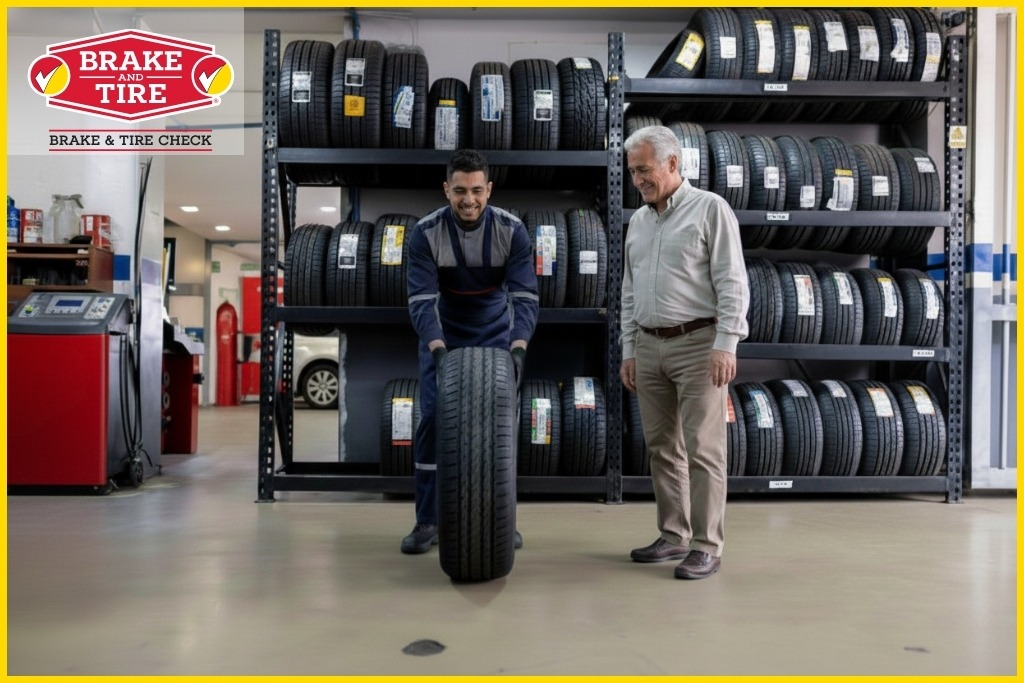
When you buy tires from Brake and Tire Check, you receive services that competitors charge extra for, or don’t offer at all.
- Free Lifetime Tire Rotation ($20-40 per rotation elsewhere = $80-160+ over tire life)
- Free Lifetime Tire Balancing ($15-25 per wheel when needed elsewhere)
- Free Air Pressure Checks (anytime, no appointment, no charge)
- Free Alignment Quick Check ($50-80 per check elsewhere)
- 3-Year Alignment Warranty Discount ($30 savings with purchase of 2 or more tires)
You save nearly $1,000 per set of tires just in free services.
Ready to Find the Right Tires?
Visit Brake and Tire Check near you and get expert advice on what will work best for your needs.
Free services start immediately with tire purchase
Frequently Asked Questions
How long do tires last in Texas?
Most tires last between 40,000 and 80,000 miles depending on brand and maintenance. However, it’s recommended to replace at 6 years maximum regardless of tread, Texas heat ages rubber faster than other states.
Should all four tires be replaced together?
Best practice: yes. Consistent tread depth improves handling and stability. If the budget requires replacing only two, install new tires on the rear axle (even on front wheel drive vehicles) to prevent rear end sliding in wet conditions.
Should tire pressure change with seasons?
No. Always follow manufacturer recommended pressure (found on driver’s door jamb sticker). Pressure adjusts naturally with temperature changes. Don’t modify it based on season.
Is mixing tire brands safe?
Not recommended. Different brands have different handling characteristics. Mixing brands can create unpredictable handling, especially in emergency situations. Consistent tires improve safety.
When should I rotate my tires?
Every 5,000-7,500 miles for even wear. Regular rotation extends tire life significantly. Free lifetime rotations are included with tire purchase at all locations.
© 2026 Peveto Companies Ltd. All Rights Reserved.
Sitemap | Accessibility Statement