


ArticlesWhen San Antonio Heat Kills Your TPMS Sensors (And How to Know)
Your TPMS light has been on for three days straight.
You checked the tire pressure yesterday. All four tires read exactly 32 PSI, the recommended level. You drove around for twenty minutes, hoping the light would reset. Nothing.
If you’ve inflated your tires to the correct pressure and your TPMS light refuses to turn off, you’re not dealing with a tire pressure problem. You’re dealing with a sensor problem, and in San Antonio’s summer heat, TPMS sensor failures spike dramatically.
In this blog, our tire shop San Antonio experts will explain why sustained summer heat kills TPMS sensors faster than moderate climates, how to diagnose sensor failure, and when to replace a single sensor rather than all four.
How TPMS Sensors Work (And Why They Fail)
Your Tire Pressure Monitoring System relies on small electronic sensors mounted inside each wheel. Each sensor contains a pressure sensor, a temperature sensor, a radio transmitter, and a small, sealed lithium battery.
The battery powers everything. When it dies, the sensor stops working, and there’s no way to replace just the battery. The entire sensor must be replaced.
TPMS sensor batteries typically last 5-10 years under normal conditions. But San Antonio’s climate accelerates failure significantly.
Why San Antonio Heat Accelerates Sensor Failure
1. Sustained High Temperatures (180+ Days)
San Antonio’s summer is nearly six months of sustained 90°F+ temperatures, from May through October.
Monthly afternoon temperatures:
- May-June: 87-94°F
- July-August: 96-97°F
- September-October: 83-93°F
That’s 180+ consecutive days of extreme heat every year. Pavement temperatures exceed 140°F during summer afternoons, meaning sensors mounted inside wheels experience even higher temperatures.
Extreme heat accelerates chemical degradation inside lithium battery cells. Every 10°C increase in operating temperature can cut battery life in half. Sensors that last 10 years in Seattle often fail at 6-7 years in San Antonio.
2. Daily Temperature Cycling (Thermal Stress)
Every day from May through October, sensors experience 20°F+ temperature swings. Morning cool, afternoon blazing hot, overnight cool again.
Every heating-cooling cycle stresses the internal components of the battery. Daily expansion and contraction weaken the battery’s internal structure. It’s not just heat; it’s the relentless daily cycle that breaks sensors down.
3. Stop-and-Go Traffic (Accelerated Drain)
TPMS sensors transmit more frequently when vehicles change speed. San Antonio’s traffic patterns, especially during summer road construction, mean more stop-and-go driving.
A sensor that transmits 50 times during a smooth highway commute might transmit 200+ times during the same distance in stop-and-go traffic. Each transmission drains the battery. Over the years, this accelerated transmission compounds heat damage.
How to Recognize TPMS Sensor Failure
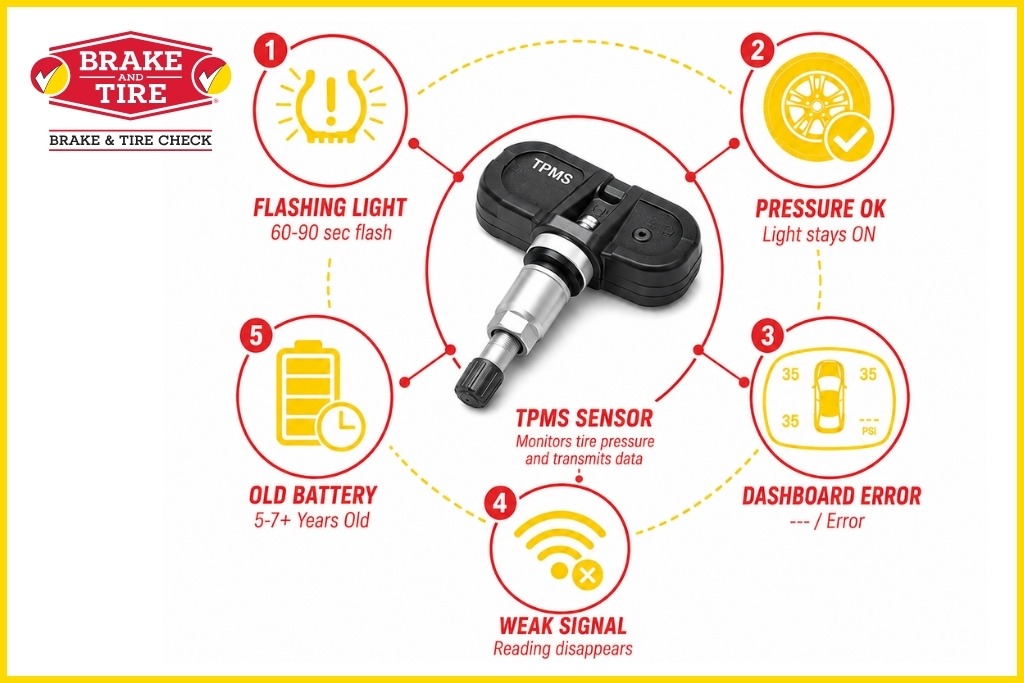
When a sensor fails, the warning light behaves differently than it does for pressure problems.
Clear sensor failure indicators:
1. Flashing TPMS light for 60-90 seconds at startup, then solid
The vehicle’s computer tries to communicate with all four sensors during startup. One isn’t responding. After 60-90 seconds, the system gives up and turns the light solid to indicate a system malfunction, not a pressure problem.
2. All tires show correct pressure, but the light won’t turn off
You check all four tires with a gauge. They all read properly. You drive for thirty minutes. Light stays on. The sensor monitoring one tire has failed.
3. One tire shows “—” or an error on the dashboard display
If one tire shows “—“, “error”, or blank reading while others show normal values, that sensor has failed.
4. Intermittent sensor readings
One tire’s pressure reading appears, disappears, then appears again. The sensor battery is too weak for consistent transmission.
5. Vehicle is 5-7+ years old with original sensors
In San Antonio’s heat, original sensors rarely last beyond 7-8 years.
Diagnosing Sensor Failure vs. Pressure Problems
Pressure problem indicators:
- Light comes on solid (doesn’t flash first)
- At least one tire measures below the recommended pressure
- Light turns off after proper inflation
- Pattern correlates with temperature changes
Sensor failure indicators:
- Light flashes for 60-90 seconds at startup, then goes solid
- All tires measure the correct pressure, but the light stays on
- One tire shows an error on display
- Light appeared suddenly
- Vehicle is 7+ years old with original sensors
The definitive test: Most tire shops can diagnose with a TPMS scan tool in 5-10 minutes. The tool checks signal strength, battery voltage, transmission frequency, and sensor ID for each wheel.
TPMS Sensor Replacement: Cost and Strategy
Single Sensor Replacement
Cost: $70-140 (sensor + programming)
When this makes sense:
- Sensor failed from physical damage (pothole, broken valve stem)
- Vehicle is relatively new (3-4 years old)
- Other sensors transmit with a strong battery voltage
Replace All Four Sensors
Cost: $260-500 (four sensors + programming)
When this makes sense:
- Vehicle is 7+ years old
- Failed sensor died from battery depletion (not damage)
- You want to avoid multiple return visits
The logic: If one sensor’s battery died after 7-8 years, the others experienced identical heat exposure. They’ll likely fail within 6-12 months. In San Antonio’s heat, sensors fail in clusters.
Most mechanics recommend replacing all four on vehicles 7+ years old. You’ll pay 40-50% less in total labor than for four separate visits.
Can You Drive with a Failed TPMS Sensor?
Legally, yes. Practically, you’re driving without a critical safety system.
What you lose:
- No warning if that tire develops a slow leak
- No alert if pressure drops dangerously low
- No protection against underinflation-related blowouts
Before TPMS became mandatory in 2008, tire-related crashes from underinflation caused thousands of deaths annually. The failed sensor might be monitoring the tire most likely to develop a problem.
Replace failed sensors as soon as possible. The $70-140 cost is far less than the cost of a blowout-related crash.
Preventing Premature Sensor Failure
1. Park in shade when possible – Reduces thermal stress by 15-20°F
2. Maintain correct tire pressure – Reduces unnecessary sensor transmissions
3. Address TPMS warnings promptly – Don’t drive for weeks with the light on
4. Protect sensors during tire service – Remind technicians to handle carefully
5. Plan for replacement around year 6-7 – Proactive replacement during tire service is cheaper than emergency replacement
Get Your TPMS Sensors Tested at Brake and Tire Check

If your TPMS light won’t turn off after confirming proper pressure, or if it flashes at startup, stop by any Brake and Tire Check location in San Antonio for a free TPMS diagnostic scan.
We’ll test:
- All four sensors for signal strength and battery voltage
- Sensor transmission consistency
- Tire pressure accuracy
- System programming
If sensors need replacement:
- OEM-quality replacement sensors
- Professional programming and installation
We have multiple locations across San Antonio. Walk-ins welcome. Open seven days a week.
Don’t let a failed TPMS sensor leave you without your vehicle’s early warning system. Get it diagnosed and replaced so your TPMS can protect you from dangerous underinflation.
Your safety system should work. Let’s make sure it does.
© 2026 Peveto Companies Ltd. All Rights Reserved.
Sitemap | Accessibility Statement