


ArticlesWhy San Antonio Tire Shops See TPMS Spikes May-October
Introduction:
You walk out to your car at 7 AM on a June morning in San Antonio. The TPMS light is glowing on your dashboard again.
You checked the pressure two days ago. Everything was fine. You drive to work, and twenty minutes later, the light turns off. The next morning? It’s back.
If you’re a San Antonio driver experiencing this, you’re not alone. Tire shops in San Antonio see a consistent spike in morning TPMS complaints from May through October, a pattern that reveals something important about how your tires respond to San Antonio’s unique climate.
Here’s what’s actually happening and when the morning warning light signals a real problem versus a normal temperature response.
The San Antonio Climate Pattern That Triggers TPMS Lights
San Antonio’s May-through-October weather follows a predictable daily temperature cycle that puts tire pressure right on the edge of triggering TPMS warnings.
Typical summer day:
- Morning (6-8 AM): 70-75°F
- Afternoon (3-5 PM): 90-96°F
- Daily temperature swing: 16-22°F
This isn’t a weekend heat wave. This is a daily reality from May through October, nearly half the year. Your tires experience this temperature roller coaster every single day for six months straight.
July and August show the most extreme pattern, 21-22°F swings daily. May and September aren’t much better. Compare this to winter, where temperature swings are smaller and absolute temperatures are lower, meaning tires stay cooler throughout the day.
The Physics: How Temperature Changes Tire Pressure
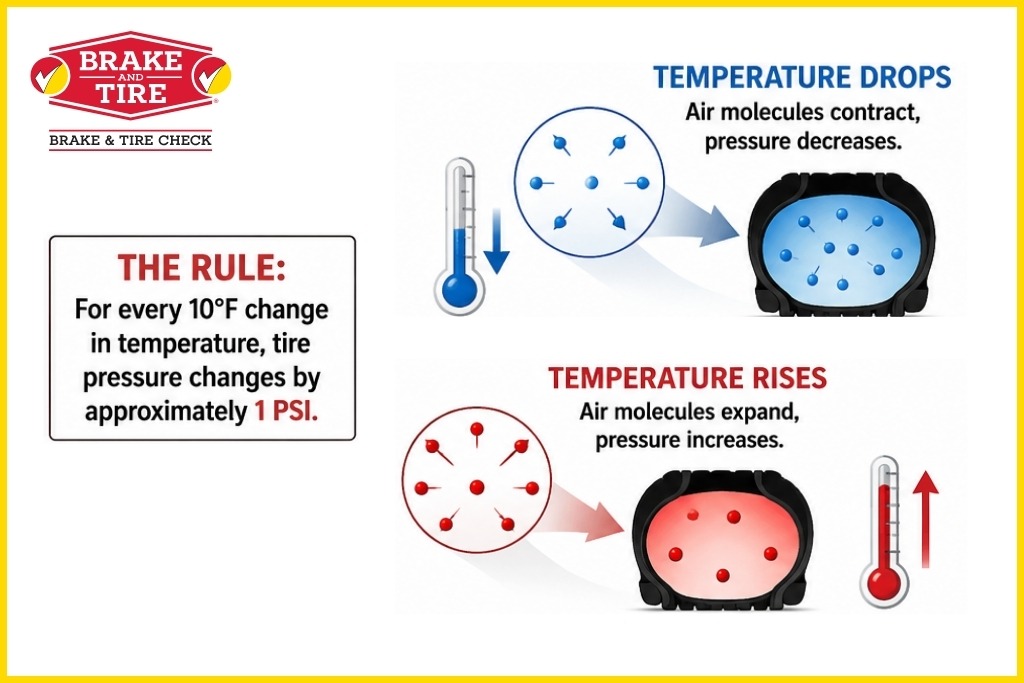
The rule: For every 10°F change in temperature, tire pressure changes by approximately 1 PSI.
Temperature drops, air molecules contract, and pressure decreases. Temperature rises, air molecules expand, and pressure increases. The rubber tire doesn’t change size, so when air volume changes, pressure changes instead.
In San Antonio’s summer pattern:
- 7 PM evening (90°F): You check tire pressure. It reads 32 PSI
- Overnight: Temperature drops to 70°F (20°F decrease)
- 7 AM morning (70°F): Tire pressure has dropped to 30 PSI (2 PSI loss)
- You drive to work: Tires heat up from friction and rising temperature
- 9 AM: Pressure climbs back to 32 PSI. TPMS light turns off
Your tires didn’t lose air. They responded to the temperature. But the 2 PSI drop triggered the warning.
When Your TPMS Light Triggers
Understanding when your TPMS triggers a warning explains why San Antonio’s temperature pattern creates so many morning alerts.
Federal law requires TPMS systems to trigger a warning when tire pressure drops 25% or more below the manufacturer’s recommended level. This threshold was chosen to alert drivers before pressure drops to a dangerously low level, but after the tire has dropped enough to affect performance and safety.
Most passenger vehicles recommend 32-35 PSI for standard tires. Let’s use 32 PSI as an example to see where the trigger point sits.
The math:
- Recommended pressure: 32 PSI
- 25% below that: 32 PSI × 0.75 = 24 PSI
- TPMS warning activates at 24 PSI or lower
This means your tires don’t need to be critically underinflated to trigger the light; they just need to be 8 PSI below the recommended level. That’s where San Antonio’s climate creates the daily morning problem.
Scenario 1: Tires are slightly low but not critically low
Afternoon (90°F): Your tire pressure reads 27 PSI. Not great, but not terrible. The car drives fine. No warning light.
Morning (70°F after 20°F overnight drop): 27 PSI minus 2 PSI = 25 PSI. You’re now just 1 PSI away from the trigger threshold. Depending on exactly how cool the morning is, you might cross into 24 PSI territory. The light comes on.
By mid-morning, when temperatures rise, and you’ve been driving for twenty minutes, pressure climbs back to 27 PSI. The light turns off. You didn’t fix anything, but the temperature fixed it for you.
Scenario 2: Tires haven’t been checked in a few months
This is the more common pattern. Tires naturally lose 1-2 PSI per month through normal air permeation ie air slowly seeps through the rubber and valve stem, even without a puncture or leak. It’s completely normal, but it’s also invisible unless you check pressure manually.
If you inflated to 32 PSI back in March:
- By May: 30 PSI (lost 2 PSI from normal permeation over two months)
- Morning temperature drop: 28 PSI
- Still above 24 PSI trigger threshold – no warning light
By July (two more months without checking):
- Afternoon pressure: 28 PSI (continued permeation, now 4 PSI below recommended)
- Morning temperature drop (20°F): 26 PSI
- Getting closer to the threshold, but still no light
By September (six months since March):
- Afternoon pressure: 26 PSI (lost 6 PSI total from permeation)
- Morning temperature drop: 24 PSI (exactly at trigger threshold)
- TPMS light comes on
You didn’t suddenly develop a leak in September. Your tires have been slowly losing pressure due to normal permeation for six months, and San Antonio’s temperature swings finally brought the morning pressure low enough to cross the trigger threshold. The temperature drop revealed a problem that was slowly building all summer.
The Morning TPMS Light: Normal vs. Concerning Patterns
Not all morning TPMS warnings signal the same problem. Understanding the pattern tells you whether you’re dealing with temperature-related pressure changes or an actual issue that needs immediate attention.
Pattern 1: Temperature-Related (Normal)
Light comes on in cool mornings, turns off within 20-30 minutes of driving. Happens consistently May-October. All four tires show similar pressure when checked cold.
What to do: Check pressure when cold and inflate to the recommended level. Warnings should stop.
Pattern 2: Slow Leak (Concerning)
Light stays on all day. One tire is consistently lower than the others. Pressure drops within days after inflating.
What to do: Get a tire inspection. Most tread punctures can be repaired for $15-30 if caught early.
Pattern 3: Sensor Failure (System Malfunction)
Light flashes for 60-90 seconds at startup, then stays solid. Light stays on even after confirming proper inflation.
What to do: The sensor has failed and needs to be replaced.
Why You Shouldn’t Ignore It
Even if your light only comes on due to temperature, it’s telling you: your tires are low enough that normal fluctuations push them into the warning zone.
- Increased tire wear: A tire underinflated by 20% can lose 25% of its tread life. You’ll replace tires at 40,000 miles instead of 60,000 miles.
- Reduced fuel efficiency: Even 3 PSI below recommended reduces fuel economy by 1%. Over a year, that’s 50-100 gallons of wasted fuel.
- Handling problems: Low pressure reduces steering response and increases stopping distance. San Antonio’s sudden summer thunderstorms make proper pressure critical for traction.
- Blowout risk: Underinflated tires flex more, generating internal heat. When temperatures are already 95°F+ and pavement exceeds 140°F, underinflated tires run dangerously hot.
The Federal Highway Administration estimates that underinflated tires contribute to approximately 660 fatalities and 33,000 injuries annually in the United States.
What San Antonio Drivers Should Do
Step 1: Check pressure when tires are cold
“Cold” means the vehicle has been parked for at least 3 hours. Check all four tires first thing in the morning before driving. Use a quality digital gauge. Compare readings to the recommended pressure on your door jamb sticker, not the tire sidewall (that’s maximum capacity, not recommended pressure).
Step 2: Inflate to the recommended level
Inflate tires in the morning when cold. If you inflate in the afternoon when it’s hot, you’ll overinflate them. By the next morning, when they cool, they’ll be at the correct pressure.
Step 3: Monitor for leaks
After inflating, monitor whether the warnings stop.
- Light stops: Problem was low pressure from permeation plus temperature
- Light returns within days: You have a slow leak, schedule inspection
Step 4: Check monthly
TPMS only alerts when pressure has dropped by 25% below the recommended level. Check manually once a month to catch problems before they trigger warnings.
During May-October in San Antonio, check every two weeks. Heat, permeation, and temperature swings mean pressure changes faster.
Protect Your Tires With Routine Pressure Checks at Brake and Tire Check

Stop by any Brake and Tire Check location in San Antonio for a free tire inspection and pressure check.
When you purchase new tires from us, you get lifetime free tire services, including rotations, balancing, pressure checks, alignment quick checks, and our 3-Year Alignment Warranty, all designed to protect your investment through San Antonio’s demanding May-October heat.
We have multiple tire shops across San Antonio. Walk-ins welcome. Open seven days a week.
Don’t let your TPMS light become background noise. Get your tires checked with us.
Find your nearest location now!
FAQs: San Antonio Tire Pressure
Is it safe to drive with the TPMS light on?
If the light is steady, you’re fine to drive to the shop, but your handling and braking won’t be 100%. If the light is flashing, pull over. A flashing light usually means a sensor failed or you’re losing air fast enough to cause a blowout.
Why does the light turn off after 15 minutes of driving?
Friction with the road heats up the air inside your tires, which raises the pressure. In San Antonio, that morning, “low” can jump back up to “normal” just from the heat of your commute. It doesn’t mean the leak is gone; it just means the tires are hot.
Could my spare tire be the problem?
Definitely. Many San Antonio drivers forget that their spare has a sensor too. If your main four tires look perfect but the light won’t quit, check the pressure in your trunk.
Can I just reset the TPMS light myself?
On most cars, the light resets itself once you hit the right PSI and drive over 20 mph for a few minutes. If it stays on after you’ve aired up, you might need a “hard reset” through your dashboard menu or a quick scan at our shop.
Why shouldn’t I just use the “Max PSI” on the tire sidewall?
The number on the tire is the “danger zone” maximum, not what’s best for your car. Over-inflating makes your ride feel like you’re driving on rocks and wears out the center of your tread early. Always stick to the sticker inside your driver’s side door.
© 2026 Peveto Companies Ltd. All Rights Reserved.
Sitemap | Accessibility Statement